Interviewing three candidates is easy to keep straight. Interviewing fifteen in a week — phone screens stacked between panel loops — is how "the Tuesday backend person, the one with the migration story" becomes a blur by Friday's debrief. The fix is a consistent interview notes template: the same sections for every candidate, evidence instead of impressions, and a rating you can defend. This post gives you the template, variants for phone screens and panels, and the AI-assisted capture workflow that lets you stay in the conversation instead of typing through it. (Looking for general meeting documentation instead? See the meeting notes template.)
Why a template beats a blank page
- Fair comparison: if every candidate is assessed in the same structure against the same criteria, Friday's debrief compares evidence — not whoever interviewed most recently or told the best story.
- Defensible decisions: notes that record job-related facts against published criteria protect everyone. Notes that record vibes ("great energy!", "not sure about fit") help no one and age badly.
- Less interviewer drift: a template with the competencies pre-filled is a quiet script — it pulls the conversation back to what the loop agreed to assess.
The interview notes template
Copy this and fill the brackets before the interview starts:
Candidate: [name] | Role: [role + level] | Stage: [screen / technical / panel / final]
Interviewer: [you] | Date: [date] | Duration: [length]
Competency 1: [e.g. role-specific skills]
Evidence: [what they said/did — specifics, numbers, quotes]
Rating: [1–4 on your scale] — [one line on why]
Competency 2: [e.g. problem-solving]
Evidence: / Rating:
Competency 3: [e.g. collaboration]
Evidence: / Rating:
Candidate's questions: [what they asked — it shows what they care about]
Flags to verify: [claims to check in references or later rounds — not accusations, just open items]
Recommendation: [strong yes / yes / no / strong no] — [the one-sentence case]
Next step: [advance to X / decline with reason / needs another signal on Y]
Three rules make it work: evidence before rating (force yourself to write what happened before scoring it), quotes over paraphrase when something is load-bearing, and job-related lines only — write every note as if the candidate might read it, because in a dispute they might.
Variants by interview stage
- Phone screen (15–30 min): collapse to logistics (notice period, location, compensation range), one or two competencies, motivation, and a clear advance/decline. Speed matters more than depth here.
- Technical interview: one competency block per exercise; capture the approach, not just the result — "asked about edge cases before coding" is stronger evidence than "solved it."
- Panel loop: same template per interviewer, filled independently before the debrief — independent ratings first, discussion second, or the loudest voice sets everyone's score. If your team uses a shared interview scorecard or evaluation form, the competency blocks above drop straight into it.
The capture problem: 15 candidates, one keyboard
The template solves structure; it doesn't solve the fact that typing through an interview costs you the interview. Candidates hear the keyboard, you miss the follow-up cue, and the notes still end up thinner than the conversation deserved. The AI-era fix is separating capture from judgment:
- Ask consent, then record. "I'd like to transcribe this so I can focus on the conversation rather than my keyboard — is that okay?" Recording laws vary and candidates deserve the choice; almost everyone says yes to that framing.
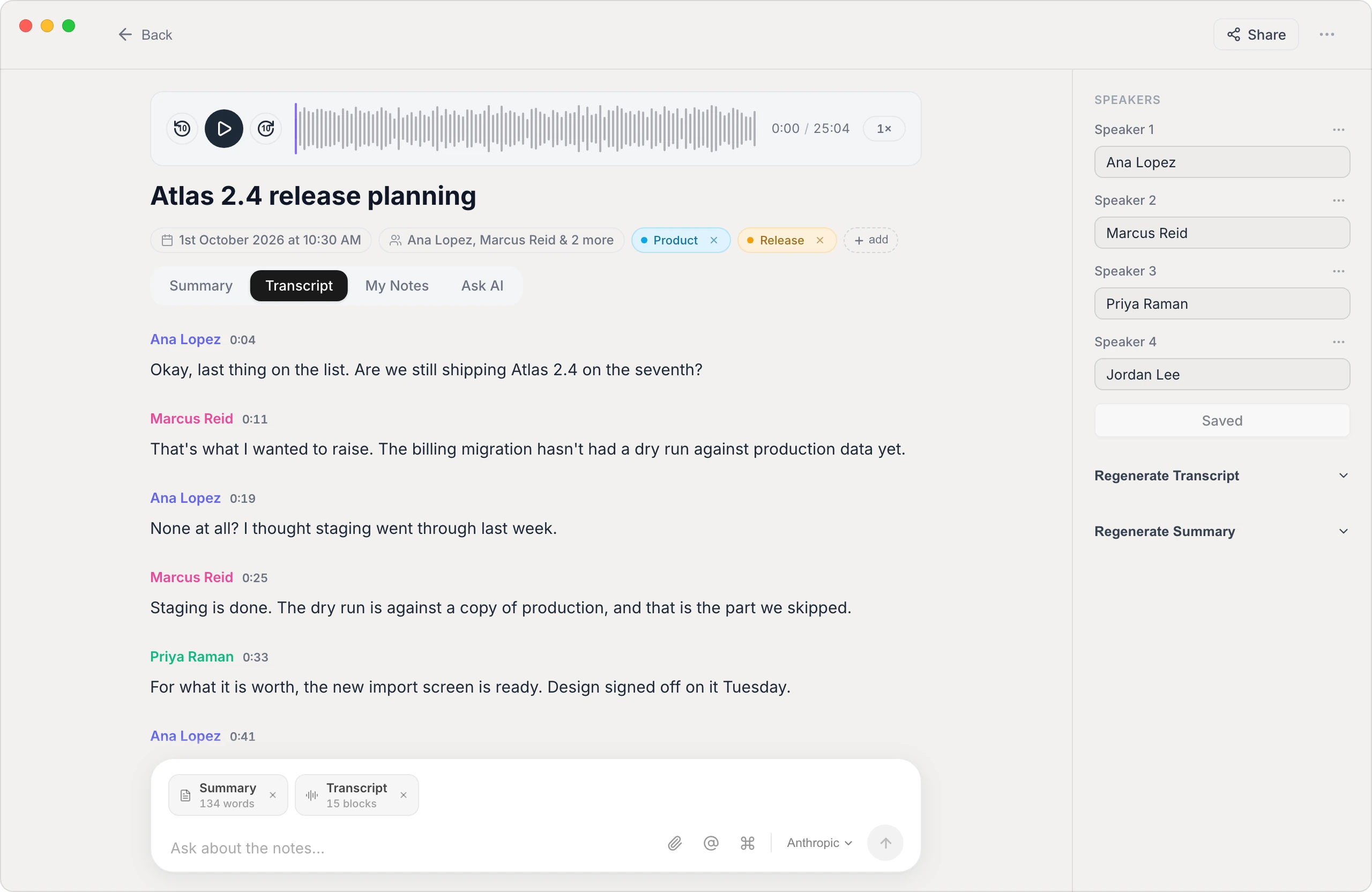
- Let the interview transcribe itself. Vowen captures the call audio on your own computer — no notetaker bot appearing in the candidate's participant list — and transcribes it on-device with speaker labels, which also means an interview full of personal data stays on your machine rather than a third-party cloud. It works the same for Zoom, Meet, or Teams interviews, and for in-person interviews via the microphone.
- Fill the template from the summary. After the call you get the transcript plus a summary with the key points and action items; your job shrinks to dropping evidence into the competency blocks and making the judgment calls — the part that was never automatable anyway.
- Debrief from evidence. When someone asks "did she actually say she led the migration, or joined it?", the transcript answers in seconds — per candidate, in the candidate's own words.
The judgment stays yours; the AI just guarantees the raw material is complete. For how this compares across tools, see the AI note taker roundup — and if you're transcribing research interviews rather than hiring ones, the interview transcription page covers that workflow.
The bottom line
Fifteen candidates a week is only unmanageable when every interview starts from a blank page and ends with reconstruction from memory. A fixed template makes candidates comparable; evidence-first notes make decisions defensible; and consent-based, on-device capture means you can actually be present in the conversation. Vowen's free tier is enough to try the capture workflow on your next screen — your Friday debrief will read differently.
See it in Vowen
Frequently asked questions
What should interview notes include?
The role and interview stage, the competencies you planned to assess, evidence for each — what the candidate actually said or did, as close to verbatim as practical — a rating per competency on your agreed scale, and a clear recommendation with next steps. Keep every line job-related: notes should record what the candidate said and did, not impressions of who they are.
How do I take interview notes without losing rapport?
Don't try to transcribe by hand. Note short evidence fragments — a number, a project name, a quote worth keeping — and hold eye contact the rest of the time. Fill in the template within ten minutes of the interview ending, while it's fresh. If the interview is recorded or transcribed (with the candidate's knowledge), your live notes can shrink to almost nothing.
Can interview notes be used in a hiring dispute?
Interview notes can be requested in disputes, which is a reason to keep them factual and job-related — evidence and ratings against published criteria, not personal commentary. Write every note as if the candidate might read it. For your organization's retention rules and anything jurisdiction-specific, ask your HR or legal team; this isn't legal advice.
Is it okay to record job interviews?
Only with consent. Tell the candidate you'd like to record or transcribe for note-taking accuracy and get their agreement — recording laws vary by region, and surprising a candidate is a bad start regardless of the law. In practice most candidates appreciate that you're focused on the conversation instead of a keyboard.
Talk instead of type.
Vowen is voice-to-text that works in any app, on Mac and Windows. Dictation is free and unlimited, no account required.